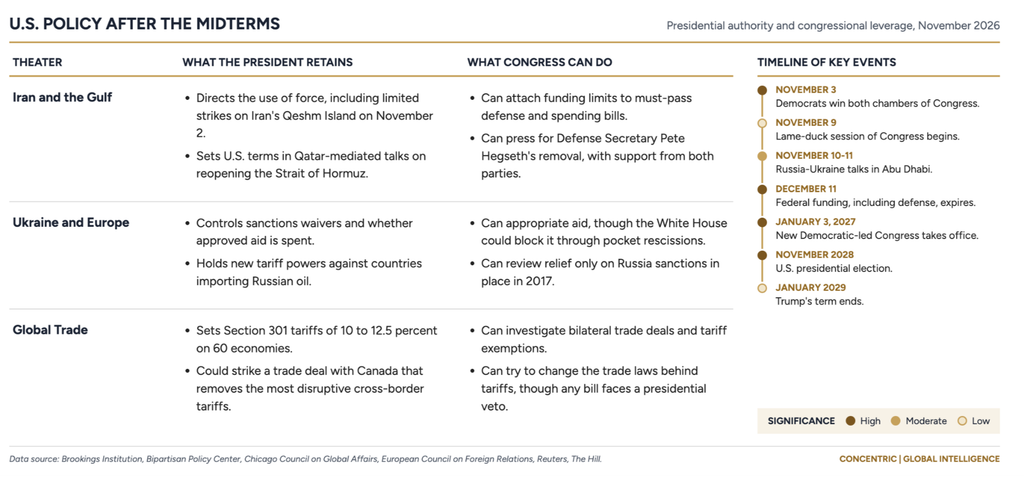
Democrats won control of both chambers of Congress in the November 3 midterm elections, partly because voters punished Republicans for the economic cost of the Iran war and tariffs. A Democratic Congress will likely raise the domestic price of President Donald Trump’s foreign policy through funding fights, oversight, and confirmation battles, but the president retains broad authority over war, trade, and diplomacy. Concentric assesses the shift in congressional control is unlikely to alter the direction of U.S. foreign policy before Trump leaves office in January 2029, though it will likely make presidential action costlier and slower.
ANALYSIS
Foreign policy rarely decides U.S. elections, but this year voters tied rising fuel and grocery prices directly to the war in Iran and the administration’s tariffs. Trump acknowledged the Iran war contributed to Republican losses and threatened to veto Democratic legislation. Republican majorities remain in place until the new Congress takes office on January 3, 2027.
The results will shift Washington from a unified to a divided government. Starting in January, Democrats will control committee agendas, subpoenas, confirmations, and must-pass spending bills. House Democratic leader Hakeem Jeffries plans to hold votes on rolling back tariffs and ending the Iran war within the first 100 hours of the new Congress. However, Democrats lack the two-thirds majorities needed to override a presidential veto, so they cannot write new limits on presidential power into law without Republican support. Concentric assesses a Democratic Congress will likely change the cost and pace of U.S. foreign policy more than its direction. Organizations should expect three effects:
- Costlier presidential action: Funding fights, investigations, and confirmation battles will likely consume the administration’s political capital. The December 11 federal funding deadline marks the main pressure point of the lame-duck session, before Democrats take control in January.
- More unilateral action abroad: With its domestic agenda blocked, the administration will likely turn further toward foreign policy, where it faces fewer constraints. After January, the administration will likely favor tools that need no new funding, such as tariffs, sanctions waivers, and diplomacy, over costly military escalation.
- Shorter-lived commitments: Allies and adversaries will likely discount executive promises that a successor could reverse after January 2029. The 2028 presidential election, not the midterms, marks the next likely turning point in U.S. foreign policy.
Iran and the Gulf
Concentric assesses a Democratic Congress will likely raise the political cost of escalation against Iran but it almost certainly will be unable to end the war. In June, the House and then the Senate passed a concurrent resolution directing an end to hostilities under the War Powers Resolution. Concurrent resolutions do not go to the president for signature, and the administration called the vote unconstitutional. On June 24, a day after the Senate vote and under pressure from Trump, Senate Republicans rejected a separate, nearly identical resolution. The Senate rejected another concurrent resolution in September. Congress’ leverage mainly applies to escalation that requires new funding. In a pre-election analysis, the Brookings Institution expected a Democratic majority to combine oversight with funding limits in must-pass defense and appropriations bills that are difficult for the president to veto.
Concentric assesses the risk of renewed large-scale strikes will likely peak during the lame-duck session, before Democrats gain control of war funding. U.S. forces struck Iran’s Qeshm Island on November 2 afterIranian forces fired on a U.S. aircraft, according to U.S. officials.
- Trump suggested before the election that the United States could escalate the war after the midterms. There is precedent: after Republicans lost Congress in the 2006 midterms, President George W. Bush escalated the Iraq war rather than change course.
- Iran’s foreign minister said a proposal developed with Qatar could reopen the Strait of Hormuz within two days of a deal. U.S. officials also described the November 2 strikes as defensive, not a resumption of major combat. Tehran characterized the strikes as part of an “ongoing war” rather than a new escalation and did not immediately retaliate militarily.
- The costs for organizations with Gulf exposure also will likely remain elevated even if diplomacy succeeds. War-risk premiums reached six to ten percent of hull value per Hormuz transit in October, compared with about 0.25 percent before the war. Insurers typically require months of sustained stability before restoring normal coverage. A deal to reopen the strait would help lower energy prices, though shipping and insurance costs would likely fall more slowly. Any renewed large-scale strikes would likely push energy prices and maritime risk higher and intensify the confrontation over war funding.
Concentric assesses there is an even chance Secretary of War Pete Hegseth will leave office before the new Congress convenes on January 3. Senate Democrats have proposed his removal as the price for cooperation on defense measures in the lame-duck session. His departure would likely have limited impact on the direction of U.S. policy on Iran.
- Lawmakers from both parties plan to hold him responsible for the war, including through an impeachment effort led by Republican Rep. Thomas Massie of Kentucky.
- Replacing Hegseth before January 3 could let the Republican-led Senate confirm a successor, though Democrats would likely use procedural delays to push a confirmation vote into the new Congress or extract other concessions.
Ukraine and Europe
Concentric assesses a Democratic Congress will likely be more supportive of Ukraine, but any aid it approves will likely be delayed or blocked. The administration used “pocket rescissions” to cancel $4.9 billion in congressionally approved foreign aid in 2025 and $810 million, mostly for domestic programs, in September 2026. Neither move targeted Ukraine aid, but the same tactic could let the White House block future Ukraine funding. In October commentary, the European Council on Foreign Relations advised European governments to count only funds that arrive.
Concentric assesses Russia sanctions policy will likely remain largely in presidential hands.
- Limited review powers: The 2017 Countering America’s Adversaries Through Sanctions Act covers only sanctions in place when it passed. A president can lift most sanctions imposed after Russia’s 2022 invasion of Ukraine without congressional review.
- Willingness to waive: In September, Congress passed the Graham Act, sponsored by late Senator Lindsey Graham, with veto-proof majorities to tighten sanctions on Russia. However, Trump used the law’s national-interest waiver to suspend those sanctions. The waiver came on October 16, a week after the Treasury Department authorized Russian diesel transactions.
- A tool against Europe: The waiver left intact the law’s tariff powers, which allow the White House to target countries still importing Russian oil, including European states. The administration has eased pressure on Moscow while keeping a tool it could turn on its allies.
U.S.-mediated talks will resume in Abu Dhabi on November 10-11, but Russian and Ukrainian red lines persist. Moscow still demands parts of Donetsk and Luhansk that its forces have failed to capture, while Kyiv seeks a ceasefire along the current front line. Concentric assesses a comprehensive settlement before the new Congress convenes is very unlikely.
Concentric assesses Moscow will likely use the rest of Trump’s term to seek concessions from the president while sustaining military pressure. Russia struck energy facilities across Ukraine and port infrastructure in Odesa on Election Day. European governments will likely continue to carry a growing share of Ukraine’s financial and military support. Even with a Democratic Congress, the administration’s reluctance to provide aid and the threat of a presidential veto make a return to large-scale direct U.S. military aid unlikely. Instead, Europe will likely keep funding U.S. weapons for Ukraine through NATO’s Prioritized Ukraine Requirements List, which supplies about 95 percent of Ukraine’s Patriot interceptors, according to Kyiv.
Global Trade
Concentric assesses tariff volatility will almost certainly outlast the midterms because many tariffs do not depend on Congress. Section 301 tariffs of 10 to 12.5 percent have applied to imports from 60 countries since July 24. Revenue reinforces their staying power, as the US has collected around $260 billion in gross tariff and related excise revenue so far in 2026, against a $2 trillion deficit.
Concentric assesses a Democratic Congress will likely attempt to roll back tariffs, but scrutiny, not repeal, will be its main source of pressure.
- Investigations: Democrats plan to investigate potential corruption surrounding bilateral trade deals and tariff exemptions.
- Legislation: The Chicago Council on Global Affairs noted reclaiming tariff authority would require Congress to change or repeal the laws the administration uses. Any such bill would face a presidential veto, and Democrats are unlikely to secure the bipartisan support needed to override one.
Concentric assesses a congressionally led rollback of tariffs is unlikely, despite Jeffries’ planned vote, but there is an even chance of a near-term trade deal with Canada that removes the most disruptive cross-border tariffs. The midterms delivered a clear political signal on trade. In the NBC News exit poll, 66 percent of voters said Trump’s tariff policies had hurt the national economy. Senate races in Maine and Michigan, where the trade war with Canada became a campaign issue, also exposed weaknesses in the White House’s trade strategy. Organizations should plan sourcing, pricing, and market strategy assuming tariff policy will remain volatile through the end of Trump’s term.
HOW CONCENTRIC CAN HELP
Concentric offers a suite of services designed to mitigate risks and enable secure business operations in unpredictable environments:
- Geopolitical Intelligence: Concentric tracks how shifts in U.S. policy reshape energy, sanctions, and trade exposure, enabling organizations to anticipate knock-on effects rather than react to headlines.
- Crisis Management and Security Support: Concentric supports organizations operating in the Gulf and Europe through contingency planning, executive protection, and crisis response.
- Travel Risk Assessments and Alerting: Concentric provides customized reports offering itinerary-focused evaluations of changing geopolitical, security, and environmental conditions. Concentric also offers tailored, real-time intelligence based on travelers’ live locations and planned movements.
Through Concentric’s advanced geopolitical intelligence strategies, businesses can effectively navigate travel risks, safeguard their personnel, and ensure operational continuity across global environments. For more information or to arrange a consultation to enhance your organization’s travel security capabilities, please contact Concentric’s Global Intelligence team today.