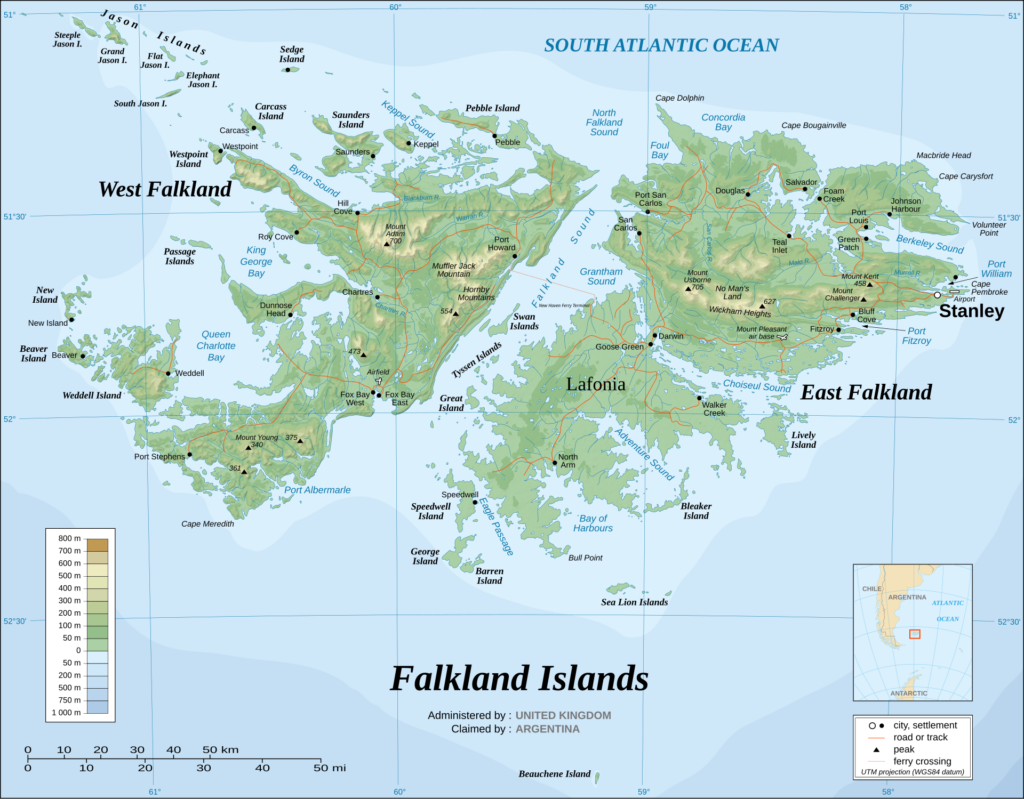
Argentina’s September 2026 sanctions campaign against the Sea Lion oil project has converted a sovereignty dispute into a commercial security risk environment across the South Atlantic. The measures are likely to increase military, market, and economic exposure for oil and gas companies, maritime operators, and their supply chains, while ambiguous U.S. signaling on the Falklands has introduced uncertainty into the credibility of U.K. reinforcement.
OVERVIEW
On September 3, Argentine President Javier Milei announced measures against companies, directors, shareholders, and suppliers connected to Falklands hydrocarbon activity, describing the Sea Lion oil field’s development as a “clear and present danger,” and stating Argentina would not “stand idly by.” The address followed U.S. President Trump stating Washington’s decades-long neutral position on Falklands sovereignty was “under review.”
The Sea Lion oil field is operated by Tel Aviv-listed Navitas Petroleum, which holds a 65 percent stake. London-listed Rockhopper, also backed by Israeli investors, owns the remaining 35 percent. The Sea Lion project reached its final investment decision in December 2025, with reserves estimated at 1.7 billion barrels in the initial phase, drilling expected to begin in early 2027, and first oil targeted for March 2028. Navitas subsequently expanded its footprint in the basin through a 2026 farm-in on license PL001, covering an estimated 3.1 billion barrels of prospective resources. Argentina’s Foreign Ministry branded the project “unilateral and illegitimate.” On September 1, Argentine environmental groups and Falklands War veterans filed suit seeking a federal injunction against the development. The U.K. government responded on September 15 by publishing “Doing Business with the Falkland Islands,” explicitly stating Argentina has no jurisdiction over the islands and Argentine notices to companies carry no legal effect.
Renewed commercial interest in the islands’ resources has become the primary accelerant of the historic sovereignty dispute, introducing a new and distinct layer of commercial and security risks.
ANALYSIS
We assess the following risks are likely to follow the trajectory of Argentina’s sanctions campaign and its effort to delegitimize the commercial interests of other states. U.S. ambiguity over the Falklands runs through several of these risks, providing Argentina political justification for escalation and introducing new uncertainty for investors and operators. Military credibility risk assesses the reinforcement gap; market risk assesses the financial-market response, primarily affecting Navitas and Rockhopper; economic exposure assesses the Falklands’ stake in the project’s continuation; and political volatility risk assesses the domestic incentives sustaining Argentina’s position.
- Military posture and reinforcement credibility: The sanctions campaign is a deliberately non-military instrument, but it is paired with a parallel military signal: Milei announced the funding of a new naval base in Tierra del Fuego, the same week as the sanctions package, framed by Buenos Aires as establishing Argentina as the primary logistical hub of the South Atlantic. This move almost certainly does not change the balance of forces on the islands themselves, with the British garrison of approximately 1,500 personnel, a four-aircraft Typhoon FGR4 detachment, the Sky Sabre air-defense system, and the patrol vessel HMS Medway. These options remain credible for deterrence, but highlights concerns around the U.K.’s ability to deploy reinforcements to the islands in an effective and timely manner, particularly given the increased Argentinian deployability provided by the new naval base in Tierra del Fuego. Reinforcements almost certainly depend on a transatlantic logistics chain assuming U.S. support; it is Trump’s ambiguity on neutrality which gives Argentina’s naval investment more political weight than its military scale alone would justify.
- Market risk: The sanctions announcement produced an immediate market reaction: Rockhopper Exploration’s value fell over 10 percent intraday on the London Stock Exchange, closing roughly 6.5 percent down, while Navitas Petroleum fell approximately 2.3 percent in Tel Aviv and Borders & Southern also declined, all on the same news cycle as Milei’s address. This is a direct sanctions-driven effect, as both operators issued a joint statement maintaining their licenses were lawfully granted and they anticipate no impact on the development timeline.
- Falklands economic exposure: The Falkland Islands’ economy is small but concentrated. The Island is home to a resident population of approximately 3,660 to 3,700, nominal GDP of approximately £175 million (2024), GDP per capita near £85,000, and fisheries/aquaculture licensing accounting for approximately 58 percent of GDP. This structure likely means the Sea Lion project revenue will diversify the island’s government income. Argentina’s sanctions are also working directly against the economic incentive of the islands’ own government, and reducing the likelihood Argentine pressure will produce local political concessions.
- Political volatility risk: The sovereignty claim is constitutionally enshrined in Argentina and is politically unifying. Milei faces domestic pressure from opposition figures who accuse him of neglecting the claim, giving him incentive to sustain or escalate the current posture ahead of his own electoral calendar. This domestic incentive structure, combined with the fixed 2027 to 2028 drilling and first-oil timeline, makes continued escalation more likely than near-term de-escalation.
OUTLOOK
Concentric assesses Argentina’s sanctions campaign is unlikely to force a change in the Sea Lion project’s ownership, financing, or development timeline. However, the widening sanctions perimeter is likely to increase pressure on the broader ecosystem of contractors, insurers, and financial institutions to sever Falklands-linked business, generating supply-chain disruption and reputational risk for any entity which continues to operate in the space.
Over the short to medium term, the most significant risks are likely to stem from the pace and scope of sanctions expansion and increased compliance scrutiny rather than a direct escalation toward military confrontation. If Argentina expands its measures to the wider pool of contractors, insurers, and banks it has signaled it may target next, both the operators and their remaining suppliers may place greater emphasis on alternative financing structures. In parallel, Argentina’s naval-base investment in Tierra del Fuego raises the likelihood of localized gray-zone friction, but without any intent toward direct confrontation with U.K. forces.
HOW CONCENTRIC CAN HELP
Concentric offers a suite of services designed to mitigate risks and enable secure business operations in unpredictable environments:
- Travel Risk Assessments and Alerting: Concentric offers customized reports offering real-time, itinerary-focused evaluations of changing geopolitical, security, and environmental conditions. We also offer tailored, real-time intelligence based on travelers’ live locations and planned movements.
- Security Operations: Concentric provides on-the-ground advisory support, executive protection, and operational security planning across Latin America.
- Evacuation and Crisis Management Planning: Concentric’s intelligence and security teams deliver crisis-management support, including evacuation route planning, maritime risk assessments, safe-haven identification, and localized emergency response.
Through Concentric’s advanced geopolitical intelligence strategies, businesses can effectively navigate travel risks, safeguard their personnel, and ensure operational continuity across global environments. For more information or to arrange a consultation to enhance your organization’s travel security capabilities, please contact our Global Intelligence team today.