Israel’s October 27 general election produced a hung Knesset. Neither Prime Minister Benjamin Netanyahu’s bloc nor the opposition led by former military chief of staff Gadi Eisenkot holds the 61 seats needed to govern. President Isaac Herzog tasked Eisenkot with forming a government on November 8, but his most viable route to a majority depends on winning over ultra-Orthodox parties, including Shas, which still backs Netanyahu. Concentric assesses a repeat election in early 2027 is likely, leaving Netanyahu as caretaker prime minister while the Gaza and Iran fronts remain unresolved. The outcome is unlikely to change Israel’s core position on Gaza, but it will likely shape West Bank policy and relations with Washington and raise the risk of domestic unrest through December 2026.
OVERVIEW
Israel’s political stability has deteriorated since the October 27 election, raising the risk of protests and unrest during an active regional war. Likud has disputed the outcome, while Herzog accepted the certified results and tasked Eisenkot with forming a government after 67 lawmakers recommended him. Eisenkot has declined to govern with Arab parties and is instead courting United Torah Judaism (UTJ) and Shas, which would give him a bare majority. That route requires Shas to break with Netanyahu and both parties to accept a compromise on military service for ultra-Orthodox men, an issue on which Eisenkot’s bloc campaigned for universal service. UTJ’s refusal to recommend Netanyahu cut his support to 46. Whoever governs, Israel is very likely to maintain its refusal to withdraw further from Gaza before Hamas disarms.
ANALYSIS
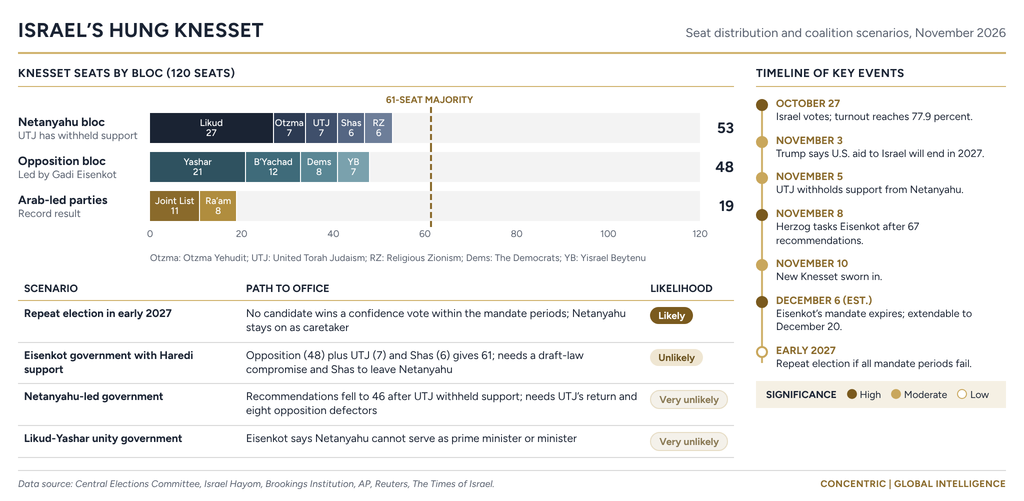
Israelis voted on October 27 in the first general election since the October 7, 2023, Hamas-led attack. Turnout reached 77.9 percent, the highest since 1999. Likud remained the largest party with 27 seats, ahead of Eisenkot’s Yashar with 21. Neither bloc reached the 61 seats needed for a majority:
- Netanyahu bloc (53 seats): Likud, Otzma Yehudit, UTJ, Shas, and Religious Zionism.
- Opposition bloc (48 seats): Yashar, B’Yachad (the joint list of Naftali Bennett and Yair Lapid), the Democrats, and Yisrael Beytenu.
- Arab-led parties (19 seats): the Joint List and Ra’am, which together nearly doubled their representation from ten seats.
Likud claimed Arab parties had “stolen” the election and has since said it will appeal the results. The Central Elections Committee found no evidence of irregularities affecting the result, and President Herzog told politicians it was time to “face reality.” A separate Shin Bet investigation into alleged foreign interference, led by Director David Zini, a Netanyahu appointee, appears to be faltering. The attorney general said the probes had found nothing that could affect the result, and police reportedly see little evidence to support the case. National Security Minister Itamar Ben Gvir called for the arrest of all Arab party leaders, and on November 8 police arrested 11 people in Lod after a far-right march through an Arab neighborhood ended in violence.
Coalition Calculations
The results favor Eisenkot, but not enough for him to govern. Opposition leaders agreed on November 3 to recommend Eisenkot and form a “national emergency government,” but remain divided over Arab parties. Eisenkot’s coalition principles require partners to recognize Israel as a Jewish state, a condition which excludes Arab-led parties, and Yisrael Beytenu leader Avigdor Liberman firmly opposes their inclusion. Ra’am and the Joint List nevertheless endorsed Eisenkot, giving him 67 recommendations, and Herzog tasked him with forming a government on November 8. He has 28 days to do so, with a possible 14-day extension. On November 5, UTJ declined to recommend any candidate, weakening Netanyahu’s position and cutting his recommendations to 46.
Eisenkot’s most viable route now runs through the ultra-Orthodox parties. Liberman, long their fiercest critic, urged the bloc to partner with UTJ and Shas, and he and Eisenkot reportedly agreed to draft a softened military enlistment bill. The opposition bloc, UTJ, and Shas would together hold exactly 61 seats. However, no formal talks have taken place, Shas remains aligned with Netanyahu, and UTJ refused to help the opposition replace the Knesset speaker. Netanyahu is reportedly pressing ultra-Orthodox rabbis to vote against any Eisenkot government. Eisenkot has also pledged to repeal the judicial overhaul and advance a state commission of inquiry into the October 7 attack. Concentric assesses these commitments raise the stakes for Likud, which is likely to resist any transfer of power through legal challenges and street mobilization.
Washington’s shifting position
U.S. President Donald Trump endorsed Netanyahu on October 18. On November 3, Trump said the United States would stop providing $4 billion in annual aid to Israel in 2027 while continuing arms sales, adding Netanyahu had raised the idea with him. After the U.S. midterm elections, Trump blamed the Republican losses on the Iran war and floated a change in U.S. ties with Israel. Eisenkot responded with a pledge to renew a bipartisan U.S.-Israel alliance. Brookings Institution analysts expect Democrats to push for tighter restrictions on U.S. weapons exports to Israel.
Gaza
The Gaza ceasefire stalled at its second phase. Hamas accepted the Board of Peace disarmament roadmap on July 30, but Netanyahu rejected it on August 9, stating the Israel Defense Forces (IDF) would not withdraw further until Hamas disarmed. On October 15, Eisenkot pledged Hamas would no longer govern Gaza within 18 months of his taking office, through the roadmap or “creative” military operations. The Jerusalem Post assessed Eisenkot would advance the roadmap with less resistance. This includes provisions for Palestinian Authority-linked technocrats, police, and international peacekeepers, and likely acceptance of partial reconstruction in exchange for partial disarmament.
- Gaza policy is on hold until a government forms. Netanyahu deferred reconstruction measures and steps to replace Hamas institutions until after the vote, and Board of Peace officials expected progress only after the Israeli and U.S. elections.
- Hamas told mediators it was not planning attacks and hoped the plan would advance after the election. Eisenkot warned Hamas is restoring its military capabilities. A caretaker period that delays phase two into 2027 would likely give it more time to do so.
West Bank
Neither candidate supports a Palestinian state, although Eisenkot favors limiting settlement to what Israeli law permits. An Eisenkot government would likely restore administrative detention for Jewish extremists, clear most of the more than 100 settler farms established under Finance Minister Bezalel Smotrich, freeze or limit new building, and halt the E1 settlement project east of Jerusalem, which Eisenkot opposes. Netanyahu would almost certainly maintain the status quo in which settlers remain protected by the IDF and Israeli police.
Iran
The election’s largest regional effect is on the Iran war, which began on February 28 with joint U.S.-Israeli strikes that killed Supreme Leader Ali Khamenei. Iran continues to obstruct shipping in the Strait of Hormuz, and the United States has blockaded Iranian ports. The vote leaves Netanyahu pressing for renewed strikes from a weaker position. In a call on October 31, he urged Trump to restart the campaign, while Trump preferred more time for Qatari-mediated talks and reportedly wanted Israel not to interfere.
- A caretaker government can legally go to war, and security is the clearest exception to its duty of restraint. Such a decision requires a vote of the government or security cabinet, not the prime minister alone, and parliamentary oversight is weakest until the new Knesset forms its committees.
- In the United States, Democrats won both chambers of Congress in the midterm elections, and Trump acknowledged the Iran war hurt Republicans. Senate Democratic leader Chuck Schumer said the Senate could use its funding power to stop the war, while Vice President JD Vance said the administration felt good about the prospects of a deal.
- Iran’s new Supreme Leader, Mojtaba Khamenei, warned hopes of a U.S. policy shift after the midterms were mistaken and any renewed war would be wider. Tehran is likely to read political weakness in both Jerusalem and Washington as a reason to hold out for better terms, prolonging disruption in Hormuz.
- Eisenkot said he saw no critical development justifying an immediate strike. He is likely to take fewer risks on Iran and voice opposition privately rather than publicly on any U.S.-Iran deal he considers insufficient.
OUTLOOK
Concentric assesses a repeat election in early 2027 is likely, and Netanyahu will almost certainly remain caretaker prime minister through the mandate periods and any new campaign. An Eisenkot-led government backed by UTJ and Shas is unlikely before the mandate expires in December. A Netanyahu-led or unity government is very unlikely. Formal talks between Eisenkot and the ultra-Orthodox parties on the draft law are the key indicator; a deal would significantly raise the likelihood of an Eisenkot government.
The deadlock is likely to sustain an elevated domestic political risk environment through December. The stolen-election narrative and far-right calls to arrest Arab lawmakers will likely drive protests in Tel Aviv and Jerusalem and confrontations around Arab towns, with a roughly even chance of isolated political violence. Phase two in Gaza is likely to remain stalled under a caretaker government, and settler violence is likely to continue.
On Iran, a unilateral large-scale Israeli strike is unlikely while Washington favors talks, but a renewed U.S.-Israeli campaign is likely if the stalled talks collapse.
If Eisenkot manages to form a government, domestic risk is likely to ease and West Bank policy to shift, although Israel’s core Gaza position is not likely to change. If coalition talks fail, a second election campaign is likely to overlap with decisions on Iran and the end of U.S. aid, sustaining elevated risk for travelers, shipping, and business operations through the first half of 2027.
HOW CONCENTRIC CAN HELP
Concentric offers a suite of services designed to mitigate risks and enable secure business operations in unpredictable environments:
- Travel Risk Assessments and Alerting: Concentric offers customized reports providing itinerary-focused evaluations of changing geopolitical, security, and environmental conditions. We also offer tailored, real-time intelligence based on travelers’ live locations and planned movements.
- Security Operations: Concentric provides on-the-ground advisory support, executive protection, and operational security planning across the region.
- Evacuation and Crisis Management Planning: Concentric’s intelligence and security teams deliver crisis-management support, including evacuation route planning, maritime risk assessments, safe-haven identification, and localized emergency response.
Through Concentric’s advanced geopolitical intelligence strategies, businesses can effectively navigate travel risks, safeguard their personnel, and ensure operational continuity across global environments. For more information or to arrange a consultation to enhance your organization’s travel security capabilities, please contact our Global Intelligence team today.