
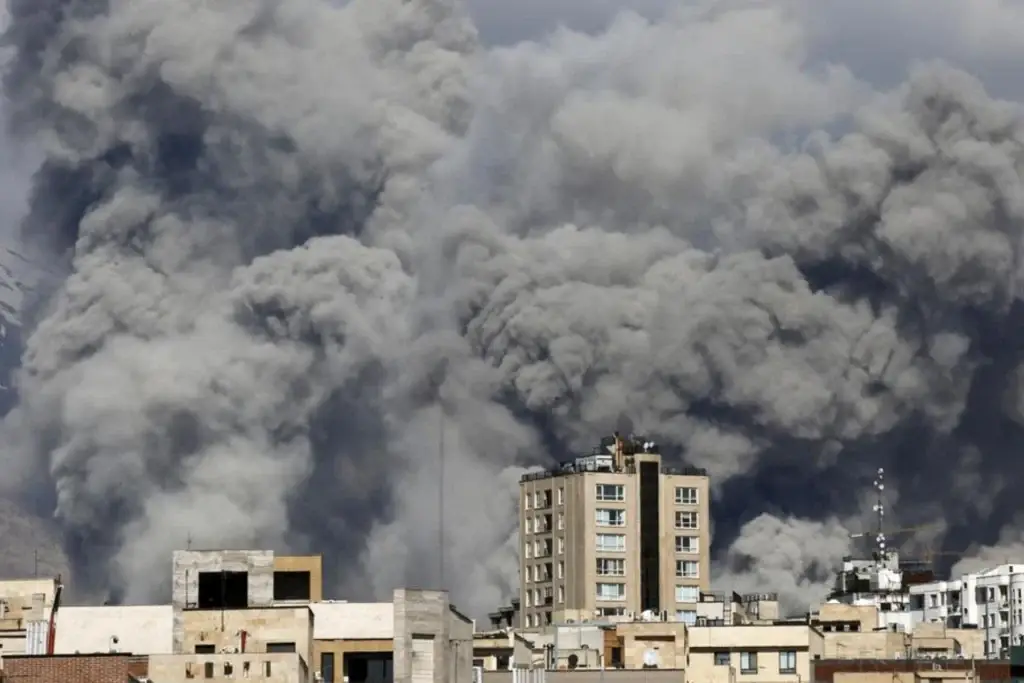
U.S.-Israel Declares War on Iran, Triggering Regional Escalation:
On 28 February, the U.S. and Israel conducted large-scale strikes across Iran, targeting senior political and the military leadership including the Supreme Leader Ali Khamenei along with 48 high-ranking officials. The operation marked a decisive escalation from prior limited military posturing to open interstate conflict. Iran responded immediately, launching missile and drone strikes against U.S., Israeli, and allied infrastructure across the region. Locations include military and energy-related targets in Cyprus, Oman, Bahrain, Iraq, Israel, Jordan, Kuwait, Qatar, Saudi Arabia, Syria, and the United Arab Emirates. Air defense systems were activated across multiple Gulf states, and widespread airspace closures were implemented, severely disrupting commercial aviation, cargo movement, and regional transit corridors. Airports in Dubai, Abu Dhabi, Manama, and Kuwait City have closed, and regional airspace shutdowns triggered cascading international flight cancellations. The conflict has rapidly expanded beyond bilateral confrontation. Iranian-aligned proxy groups, including Hezbollah, have engaged in renewed missile exchanges with Israel, while other affiliated militias in Iraq and Syria are assessed likely to intensify attacks on U.S. assets. In addition, maritime risk in the Strait of Hormuz and surrounding Gulf waters has risen sharply, with elevated threats to commercial shipping, offshore energy infrastructure, and port operations.
We advise companies with personnel, assets, or transit exposure in the Middle East to activate crisis management and evacuation contingency plans immediately, reassess travel, and prepare for extended airspace closures and maritime disruption. Executives should stress-test regional business continuity plans, assess exposure to gulf energy and shipping routes, and prepare for prolonged disruptions to aviation, financial markets, and cross-border operations as the conflict remains highly fluid.
Austin Shooting Raises Concerns of Conflict-Linked Domestic Extremism:
A 53-year-old gunman, identified as Ndiaga Diagne, opened fire outside a bar in Austin, Texas, killing at least two people and injuring more than a dozen others before being shot and killed by police. Authorities report the attacker initially fired from his vehicle using a handgun before exiting with a rifle and continuing the assault in the city’s Sixth Street entertainment district, a densely populated nightlife and tourism area. Federal officials confirmed Diagne, a naturalized U.S. citizen originally from Senegal, posted pro-Iranian and anti-U.S. and anti-Israeli content on social media in the days prior to the attack. Law enforcement sources indicated that clothing bearing religious and Iranian-affiliated symbolism was recovered at the scene. The FBI is investigating the incident as a potential act of terrorism, particularly given the heightened domestic security environment following recent U.S.–Israeli military operations against Iran. Although authorities have not formally designated the attack as terrorism, the ideological indicators and timing, coinciding with escalating Middle East hostilities, elevate concern over copycat or retaliatory violence by self-radicalized individuals. Lone-actor attacks remain the most plausible short-term threat vector. Officials are also assessing the possibility of activation of Iranian-linked networks or “sleeper cells;” while considered less likely, such a development would represent a higher-impact and more coordinated threat scenario.
We advise travelers and companies to review security protocols, reinforce situational awareness around, and monitor local law enforcement advisories. Travelers should identify emergency exits in venues, enable real-time travel alerts, and remain prepared for short-notice security restrictions or police activity in response to evolving threat conditions.
Cloud Intrusions Surge as AI-Powered Cyber Attacks Evade Defenses:
A recent cyber-security report highlighted an alarming rise in AI-driven intrusions targeting corporate cloud environments, in which attackers are leveraging generative AI to bypass traditional defenses and automate reconnaissance. Researchers and industry analysts note that threat actors are increasingly weaponising AI both to identify exposed cloud assets and to exploit them rapidly, using techniques that blend into trusted SaaS and cloud infrastructures, enabling data theft, ransomware deployments, and persistent access while evading legacy security controls. This shift means that AI is no longer just a component of attacks but is increasingly embedded within the attack lifecycle itself, empowering unsophisticated actors to conduct complex cloud compromises that can unfold far faster than traditional detection and response mechanisms can counter.
We advise business leaders to adopt AI-aware threat detection and are continuously monitored and segmented to limit movement.