
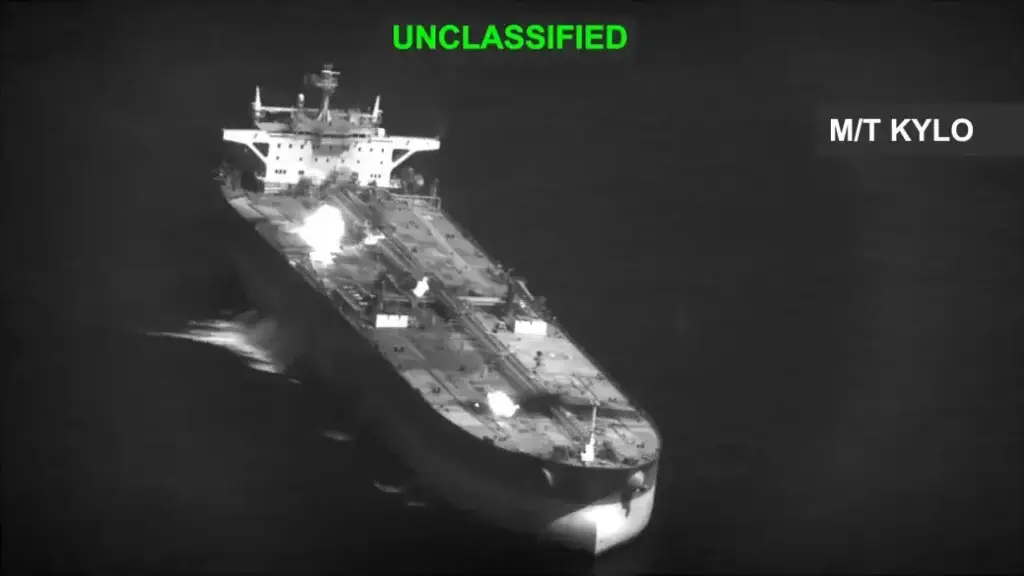
U.S. Strikes Three Iranian Oil Tankers After IRGC Missile Attack on Carrier
U.S. Central Command (CENTCOM) forces struck three Iranian crude carriers on September 5, permanently disabling the Iranian-flagged MT Downy off Kharg Island and MT Stark 1 off Jask, and hitting the Comoros-flagged MT Kylo in the Gulf of Oman, forcing its crew to abandon ship. The strikes followed an IRGC ballistic missile launch at a U.S. aircraft carrier and a guided-missile destroyer, both of which evaded without casualties. The exchange began on September 1, when CENTCOM hit roughly 60 IRGC targets while escorting 40 commercial vessels carrying 18 million barrels through the strait, a wartime high. Iran attacked at least 13 commercial vessels in August, one of which killed two seafarers. U.S. Vice President JD Vance ruled out talks until Iran stops attacking shipping. Strikes have moved beyond the strait to Iran’s principal export terminal at Kharg Island, and transit figures are now openly contested, with Treasury Secretary Scott Bessent citing 10 million barrels per day against International Crisis Group estimates of five to seven million, versus a pre-war baseline of roughly 20 million.We advise organizations with maritime, energy, or Gulf supply chain exposure to treat transit figures from both governments as unreliable and to base routing decisions on independently verified shipping data. Rerouting via the Yanbu pipeline is not a safe fallback, given Houthi targeting of Saudi-linked vessels. Companies with seafarers or contracted crews should reconfirm duty-of-care arrangements and war-risk insurance terms, as vessel attacks are now producing fatalities.
Brent Tops $95, Pushing Bond Yields to Multi-Year Highs
Brent crude traded near $96 a barrel on September 4, up more than eight percent across the week and its strongest weekly performance since July. The move fed directly into sovereign debt markets. The U.S. 10-year Treasury yield rose above 4.8 percent, its highest in roughly three years, while the two-year reached 4.41 percent, up from about 3.50 percent at the start of 2026. The sell-off is global: Japan’s 10-year touched 3.01 percent, a level not seen since the 1990s, Germany’s hit a 15-year high at 3 percent, and Australia’s a 15-year peak of 5.198 percent. U.S. equities fell on September 1, with the Dow closing down 419 points, and the U.S. average gasoline price stayed above $4 per gallon every day in August for the first time on record. Bessent has argued crude will return to $40–$50 once the Iran conflict ends, but that forecast is conditional on a resolution for which there is no timetable, and OPEC+ has already completed the rollback of its voluntary cuts, leaving limited spare capacity to absorb further disruption. We advise organizations to treat elevated funding costs as the planning baseline for the fourth quarter and into 2027 rather than a temporary spike, and to stress-test any Q4 refinancing against yields remaining at current levels. Because the sell-off spans U.S., European, Japanese, and Australian sovereign debt simultaneously, shifting exposure between these markets does not diversify the underlying risk. Fuel, freight, and energy surcharge assumptions in 2027 budgets should be revisited now rather than at year-end.
Philippine Vice President Posts Bail as Political Confrontation Escalates
A Quezon City court issued an arrest warrant on September 4 for Vice President Sara Duterte on three counts of grave threats, after judges rejected a defense motion to defer it. Duterte appeared voluntarily the following day, posted bail of 120,000 pesos per count, and had the warrant lifted, telling reporters outside the courthouse that she did not feel safe. The charges stem from a 2024 press conference in which she said she had arranged for President Ferdinand Marcos Jr. and two others to be killed if she were killed first, remarks she later said were misconstrued. The same allegations sit at the center of her Senate impeachment trial, now past its twenty-first sitting day, where a conviction would remove her from office and permanently bar her from public life despite surveys still showing her as the leading candidate to succeed Marcos in 2028. The warrant comes after a year of recurring street protests. Anti-corruption protests over the flood control scandal have drawn crowds into the streets three times since September 2025, most recently in February, when demonstrators clashed with police in Manila.We advise organizations with personnel or operations in Metro Manila to anticipate episodic, short-notice mobilization tied to court and Senate dates rather than sustained disruption, with the principal flashpoints at the Senate complex in Pasay City, the EDSA Shrine and People Power Monument in Quezon City, and Luneta Park and Mendiola in Manila. September 21, the martial law anniversary, has anchored large-scale protest activity in each of the past two cycles and should be treated as an elevated-risk date. Journey management plans should route around these sites, and foreign national staff should be reminded that participating in demonstrations can carry immigration consequences.