KEY INSIGHTS
Italy faces a low-level persistent domestic security threat from militant anarchists, with recent attacks indicating renewed activity by the insurrectionist fringe and Informal Anarchist Federation/International Revolutionary Front (FAI/FRI)-aligned cells. The rail sabotage incidents during the Winter Olympics and the accidental explosion outside Rome in March demonstrate the movement’s continued intent to target strategic infrastructure and its experimentation with improvised devices. The movement’s decentralized structure means disruption of individual cells is unlikely to eliminate the threat, and railways, telecommunications, electrical infrastructure, government and law-enforcement facilities, and defense companies such as Leonardo will remain the most exposed targets. Concentric assesses further attacks will likely remain sporadic, low-complexity, and primarily intended to disrupt operations, damage property, and generate political attention rather than cause mass casualties.
KEY EVENTS
- June 16, 2026: Police arrested seven people accused of belonging to an anarchist militant network and carrying out sabotage on a high-speed railway line during the Winter Olympics in February.
- April 30, 2026: Italy’s Justice Ministry renewed anarchist revolutionary Alfredo Cospito’s detention for a further two years, with the decree citing the March explosion as evidence of still-active radicalized FAI/FRI cells.
- March 20, 2026: An explosion at a disused farmhouse outside Rome killed two anarchist activists, who investigators concluded were assembling a homemade device.
- February 14, 2026: Anarchists detonated improvised explosive devices on the Rome-Florence high-speed line, with a simultaneous claimed action on the Rome-Naples route.
- February 7, 2026: On the first full day of the Winter Olympics, anarchists damaged rail infrastructure near Bologna. The Ministry of Transport called the incidents an act of “serious sabotage.”
- November 20, 2025: The United States formally designated FAI/FRI, alongside Germany’s Antifa Ost and two Greek groups, as a Foreign Terrorist Organization and Specially Designated Global Terrorist entity, citing more than two decades of bombings and letter bombs against political and economic institutions.
ANALYSIS
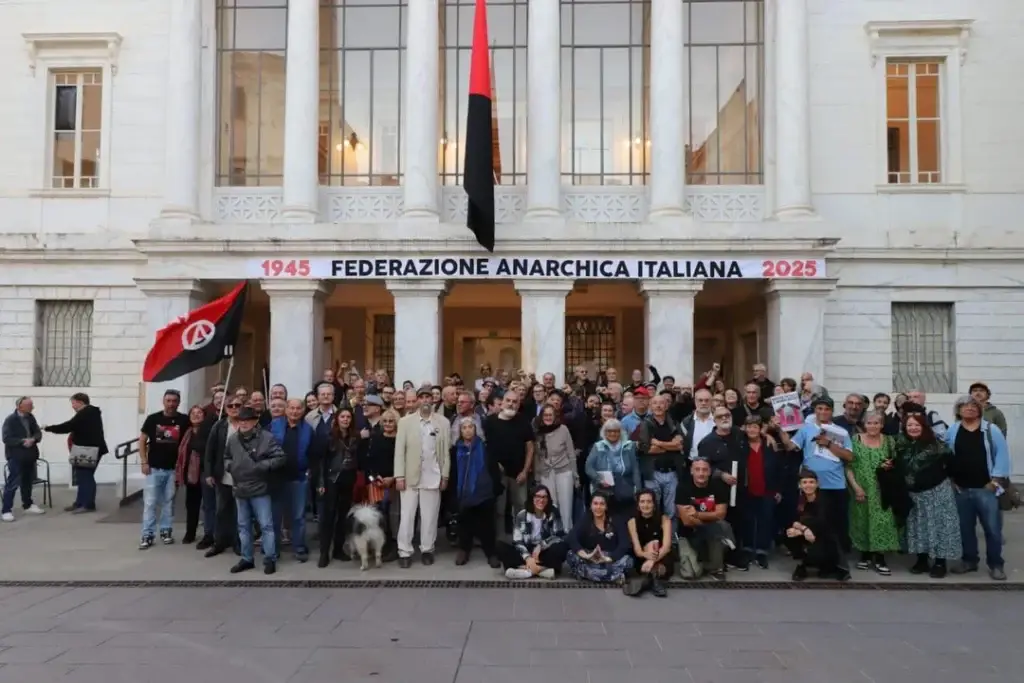
Italy’s anarchist movement has been present in the country for more than a century and a half, taking root within the Italian section of the First International in 1869. The movement survived fascist suppression, contributed to World War II Resistance, and re-established a national structure with the founding of the synthesist Italian Anarchist Federation at Carrara in 1945.
- It re-emerged as a security concern during the “Years of Lead” of the 1970s and 1980s, a period of sustained left-wing and right-wing terrorism. The insurrectionist theory was developed by writers such as Alfredo Maria Bonanno, which continues to shape the violent fringe today.
The current security threat comes from the insurrectionist fringe, with an ideology rooted in the writings of Alfredo Maria Bonanno and given organizational form in the FAI/FRI, which disregards formal structures and pursues violent direct action against the state, law enforcement, prisons, corporations, and infrastructure. Italian parliamentary and interior ministry assessments describe the contemporary movement as predominantly nonviolent while identifying this radical minority, which analysts have assessed to be the leading source of domestic non-jihadist terrorism in the country.
- Europol’s 2025 situation report recorded 21 left-wing and anarchist attacks across the European Union in 2024, of which 18 occurred in Italy, and Italy registered more terrorist attacks overall than any other member state.
The FAI/FRI is the most internationally recognized element of Italian militant anarchists. It emerged publicly in December 2003, when they claimed two bombs were left outside the Bologna home of Romano Prodi, then president of the European Commission, and set out its purpose in an open letter calling for a horizontal organization without leaders or central committees.
- It operates as a fluid network of small “affinity groups” and individuals who act autonomously while claiming attacks under a shared banner. The International Revolutionary Front serves as the transnational label linking like-minded cells and gives the network self-proclaimed affiliates across Europe, South America, and Asia.
- Its methods have centered on letter and parcel bombs, incendiary devices, and sabotage aimed at political, military, and economic institutions.
- In June 2022, FAI/FRI claimed responsibility for sending a letter bomb to Alessandro Profumo, the chief executive officer of Leonardo. Criticizing the company for trading arms with Russia and Ukraine.
- Alfredo Cospito claimed in 2012 one of its cells shot and wounded the chief executive of Finmeccanica, the predecessor to Leonardo. Consistent with insurrectionist doctrine, these actions have been meant to damage property and intimidate rather than to inflict mass casualties.
The recent escalation has implied a renewed coordinated sabotage campaign.
- The attacks on rail lines in February used crude incendiary and improvised explosive methods to interrupt high-speed services at the height of the Olympics. The motive was cited as opposition to the Games, anti-militarism, and attacks on strategic infrastructure. In June, police arrested seven anarchists involved in the sabotage operation. The charges included terrorist association and subversion of the democratic order.
- Investigators concluded the explosion in March was the result of anarchists handling a device built from agricultural fertilizer and a homemade detonator, and the presence of nails pointed to an intent beyond pure demonstration. The intended target has not been established: the interior ministry’s counter-terrorism analysis committee weighed a nearby rail junction, a police complex, and Leonardo facilities. Leonardo is an aerospace, defense, and security company headquartered in Rome.
OUTLOOK
Concentric assesses militant anarchists will likely continue to conduct sporadic sabotage and low-complexity attacks against infrastructure, government facilities, law enforcement, and corporations perceived to embody the state, capitalism, or militarism. The operation in June disrupted one alleged cell, but the network’s decentralized character makes it a realistic possibility activity resumes rather than subsides. Railways, telecommunications, and electrical assets remain the most exposed target set, and defense firms such as Leonardo face a distinct symbolic risk given their repeated appearance as named or suspected targets.
Aggravating factors include periodic reviews of Cospito’s detention, anniversaries linked to imprisoned or deceased militants, evictions of occupied social centers, and major international events, any of which may prompt reactive waves of arson, parcel bombs, and rail line sabotage. We assess mass-casualty attacks remain unlikely because the operating model used by the FAI/FRI has consistently targeted infrastructure or prominent individuals. Nonetheless, the explosion in March shows continued experimentation with unstable devices sustains a persistent risk of casualties, whether accidental or intended.
For organizations operating across Italy, particularly in aviation, logistics, defense, energy, and critical infrastructure, consider the following measures:
Operational resilience: Organizations dependent on rail or other national infrastructure should hold alternative transport and logistics plans, particularly around major political and international events when symbolic targeting peaks.
Protective security: Operators of infrastructure, government-linked sites, defense firms, and financial institutions should review physical security around dispersed and publicly accessible assets, with attention to track-side cabling, signaling cabinets, and electrical cabins.
Duty of care: Security teams should track anarchist mobilization and developments involving Alfredo Cospito, as these have repeatedly preceded direct action.
Authored by: Alex Edwards