KEY INSIGHTS
Cameroon is facing growing pressures on its stability as terrorist violence expands in the Far North, while President Paul Biya’s recent prolonged 73-day absence and continuing succession uncertainty raise questions about institutional continuity in Yaoundé. Jama’atu Ahlis Sunna Lidda’awati wal-Jihad (JAS), commonly known as Boko Haram, and the Islamic State West Africa Province (ISWAP) are extending their reach through the appointment of additional Cameroonian commanders. Both factions rely on local recruitment, cross-border logistics, kidnapping, extortion, and attacks on military outposts. Concentric assesses in the near term violence will likely remain concentrated in Mayo-Sava, Mayo-Tsanaga, and Logone-et-Chari, but political and security confidence across the country will continue to be negatively impacted by succession uncertainty.
KEY EVENTS
- August 20, 2026: Paul Biya returns to Cameroon after 73 days. The President gives no public address but is pictured alongside his wife in transit.
- August 3, 2026: President Biya signed three defense decrees reshuffling leading military positions, including appointing five brigadier generals.
- July 31, 2026: The United Nations Office for the Coordination of Humanitarian Affairs (OCHA) reported 207 non-state armed group incidents, 72 deaths, 48 injuries, and 308 kidnappings in Cameroon’s Far North between April and June 2026.
- June 7, 2026: The presidency announced Biya had left Yaoundé with Chantal Biya for a private stay in Europe.
- April 14, 2026: Cameroon passed Law No. 2026/002, which amended the constitution and reintroduced the vice presidency.
ANALYSIS
Boko Haram-linked groups in Cameroon’s Far North increasingly rely on local networks. The threat is no longer limited to cross-border spillover from Nigeria’s Borno State. ISWAP and JAS increasingly rely on dedicated Cameroonian commanders who provide local terrain knowledge, language access, community contacts, target information, recruitment channels, and logistical support. These networks enable both groups to conduct frequent attacks inside Cameroon while maintaining rear bases and supply corridors across the Cameroon-Nigeria border.
- Attack data shows sustained escalation. The Institute for Security Studies reported networks operating under Cameroonian commanders conducted 714 reported attacks in 2025 and 227 from January through June 2026. Cameroon’s Far North recorded the highest number of Boko Haram-related incidents in 2025 among the eight Lake Chad Basin regions.
- The Armed Conflict Location & Event Data (ACLED) recorded more than 300 clashes involving Boko Haram and ISWAP in the Lake Chad region during the first quarter of 2026. This marked a 30 percent increase from the previous quarter.
- OCHA reported 207 non-state armed group incidents in the Far North between April and June 2026, including 308 kidnappings. Kidnappings more than doubled from the same period in 2025.
Recent attacks have reached areas further south than communities traditionally exposed to Boko Haram-linked violence. ISWAP recently tasked Abu Zara, a Cameroonian from Mayo-Sava, with establishing a cell near the Waza National Park. If established, the cell could increase pressure on border corridors, expose communities along National Road No. 1, and increase displacement risk. A sustained escalation could spread violence beyond established border zones and disrupt movement between the Far North and adjacent regions.
- ISWAP and JAS retain significant operational reach and are expanding southward through mobile attacks, improved capabilities, and local command networks.
- Raids, kidnappings, looting, extortion, improvised explosive device (IED) activity, and attacks on military outposts are common modus operandi.
The regional counterterrorism environment has become less favorable. ISWAP and JAS benefit from gaps in the Lake Chad Basin security architecture. Gaps include the absence of the major Multinational Joint Task Force (MNJTF) operations since Lake Sanity 2 ended in July 2024. Niger’s withdrawal from the MNJTF further weakened the force’s regional structure. Recent U.S. security engagements may partially mitigate the threat but are unlikely to provide a structural solution.
- The May 7, 2026, meeting with U.S. Africa Command (AFRICOM) Deputy Commander Lt. Gen. John William Brennan Jr. confirmed continued U.S.-Cameroon security cooperation and U.S. support against Boko Haram.
Additional U.S. engagement could improve training, intelligence, surveillance, and reconnaissance (ISR) capacity, and tactical visibility along the expanding frontier. However, the to-date limited external support is unlikely to dismantle growing command networks, recruitment systems, extortion economies, or cross-border trade channels sustaining ISWAP and JAS. Concentric assesses additional support is more likely to produce localized tactical gains than a strategic reversal.
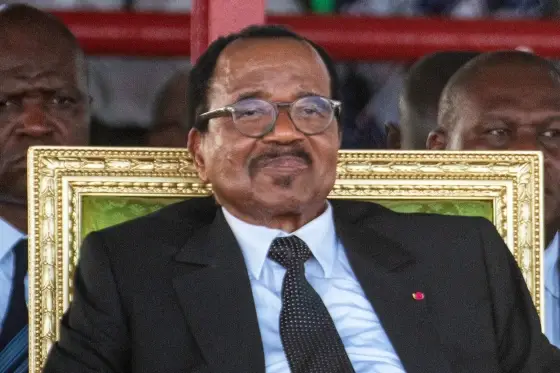
Compounding challenges, President Paul Biya’s recent prolonged absence intensified concerns over succession and the continuity of executive authority. The Director of the Civil Cabinet of the Presidency announced President Biya had left Yaoundé on June 7 for a “brief private stay” in Europe, but he did not return until August 20, after 73 days abroad – the longest recorded absence of his presidency. President Biya was pictured arriving in Yaoundé briefly waving to supporters from his vehicle, but he made no public address or disclosure regarding his health. At age 93, his return reduces immediate speculation over a power vacuum but does little to resolve Cameroon’s underlying succession uncertainty. Despite his absence, the state continued to operate through decrees issued in President Biya’s name, including defense appointments on August 3. Central authority remains formally intact, but executive visibility, return timing, and succession remain uncertain.
An April constitutional amendment reintroduced the vice presidency and gave President Biya authority to appoint and dismiss a vice president.
- Under the new system, the vice president could serve the remainder of a presidential term if the president died, resigned, or became incapacitated.
- The amendment supersedes the previous arrangement, under which the Senate president would assume temporary leadership pending a new election.
However, the office has remained unfilled as of mid-August, limiting the amendment’s stabilizing value. This resilience mechanism matters particularly in a system where the president has long concentrated executive authority.
OUTLOOK
The Far North security environment and succession uncertainty are indirectly connected. Local command adaptation, cross-border logistics, regional security fragmentation, and coercive resource extraction are driving the expansion of ISWAP and JAS. President Biya’s absence is not causing this expansion. However, insurgent pressure is rising as the long-serving president, often portrayed as a stabilizing figure, becomes less visible and the succession process remains unresolved. This combination could amplify the effects of another shock, including a major attack, an elite split, a disputed vice-presidential appointment, or a further prolonged presidential absence.
Concentric assesses Boko Haram-linked violence will likely remain elevated in the Far North, particularly in Mayo-Sava, Mayo-Tsanaga, Logone-et-Chari, and the Waza corridor. The most likely threat pattern includes continued raids on villages, attacks on isolated military posts, localized kidnappings for ransoms, looting, extortion, and disruptions along vulnerable roads and border corridors. A major territorial seizure remains less likely than continued coercive pressure.
Political instability will remain elevated despite President Biya’s return, particularly given the continued absence of an appointed vice president, the president’s advanced age, and the uncertainty of succession. Recent defense decrees show the state remains operational. However, prolonged presidential absences are likely to increase elite maneuvering, deepen public speculation, and reduce confidence in centralized crisis management during heightened insecurity in the Far North.
RECOMMENDATIONS
For organizations operating in Cameroon, particularly in the Far North, we advise considering the following:
- Movement Security: Review routes, driver procedures, check-in requirements, and alternatives for travel in Mayo-Sava, Mayo-Tsanaga, Logone-et-Chari, and near Waza National Park. Limit nonessential travel near the Nigerian border and along exposed roads.
- Personnel Preparedness: Ensure staff know emergency communication procedures, shelter-in-place protocols, muster points, and escalation measures for attacks, kidnappings, military operations, or sudden road closures.
- Protective Intelligence Monitoring: Track militant activity, kidnapping trends, military deployments, President Biya’s public status, vice-presidential appointments, and elite political maneuvering. Use defined indicators to guide travel restrictions, site closures, and temporary relocations.
- Security Coordination: Maintain regular contact with trusted local partners, security providers, and diplomatic representatives for timely updates on militant activity, political developments, and movement conditions.
Authored by: Oliver Maund